 Topit
Everyday photos
How to Pick the Best Group Photo From a Burst
One person mid-blink ruins a group photo for everyone, and the bigger the group, the likelier it gets. Here is how to make sure a good frame exists, and how to find it.
The short answer
Take more frames than feels necessary, in burst mode, and more the bigger the group. Then go face by face through the best few at full size: eyes open, mouth not mid-word, nobody hidden. The best group photo is the one with no veto, not the one where you look best, so let everyone see the finalists before anything is posted.
Group photos fail differently from photos of one person. A portrait is good or not. A group photo is only as good as the worst face in it, and every person in the group will look at their own face first.
Why one frame is never enough
Suppose each person has a 1 in 20 chance of blinking, looking away or talking in any given frame. That is a made-up number for illustration, but the shape of the result holds for any number you pick: the chance that everyone is fine at once falls fast as the group grows.
| People in the photo | Chance one frame has everyone fine |
|---|---|
| 3 | 86% |
| 5 | 77% |
| 10 | 60% |
| 20 | 36% |
| 30 | 21% |
So a burst of several seconds is not overkill for a group of ten. It is the minimum. Tell people you are taking a few, keep shooting through the moment after everyone relaxes, and you will often get the best frame there.
The face-by-face pass
Do not try to judge twenty frames by looking at them whole. At phone size, a closed eye is a few pixels. Instead:
- Pick the three to five frames where the whole composition works: everyone in, nobody cut off at the edge, the light even across the group.
- Zoom in on each and go person by person, left to right. Eyes open, mouth not mid-word, face not behind someone's head, nobody looking at their phone.
- Mark the frames that fail on anyone. What is left is your shortlist.
The no-veto rule
People recognise their own face as more attractive than it is and prefer flattering versions of themselves1, and in research on profile photos, people chose less flattering images of themselves than strangers did.2 In a group photo that bias runs in every direction at once: you will pick the frame where you look best, and so will everyone else.
The best group photo is the one with no veto. Show the shortlist to the group, let each person strike any frame they cannot live with, and choose among what survives. If that is more than one frame, any of them is fine, and the one where the most people are laughing usually wins.
When no frame works
Pick the frame with the fewest problems and check whether the problem is at the edge, where a tighter crop removes it. Some phones can swap in a face from another frame of the same burst; that works best when every frame was taken from the same spot seconds apart. If none of that saves it, take it again while everyone is still there. Retaking costs a minute. A group photo with a bad face of a friend in it gets posted anyway and remembered.
Frequently asked questions
How many photos should I take of a group?
More than you think: a burst of a few seconds for small groups, and several bursts for groups of ten or more.
Should I post the one where I look best?
If it is going on your own dating profile, use the one that works for you. If it is going to the group chat or a shared post, use the one with no veto.
How do I ask the group which one to post without starting an argument?
Send two or three finalists, not twenty, and let people vote separately rather than in the group thread. Our guide to getting honest feedback on photos explains why separate votes are more useful.
How Topit does it
Choosing group photos with Topit
Topit is a photo selector app. Upload a batch of photos, pick where they are going (a dating app, Instagram or LinkedIn), and Topit ranks the whole set for that destination, learns your taste as you compare, and explains every pick. Free to try on iPhone, Android and the web.
The problem
A good group shot is a burst of twenty frames that look identical until you zoom in, and everyone in it is checking their own face first.
How Topit solves it
Upload the burst and Topit collapses near-identical frames, showing the strongest one of each group with the others a tap away, and explains its pick. Topit judges each frame as a photo; it does not check every face for closed eyes, so do the face-by-face pass below on its top few. Then send the finalists to the group and let everyone vote, by name or anonymously.
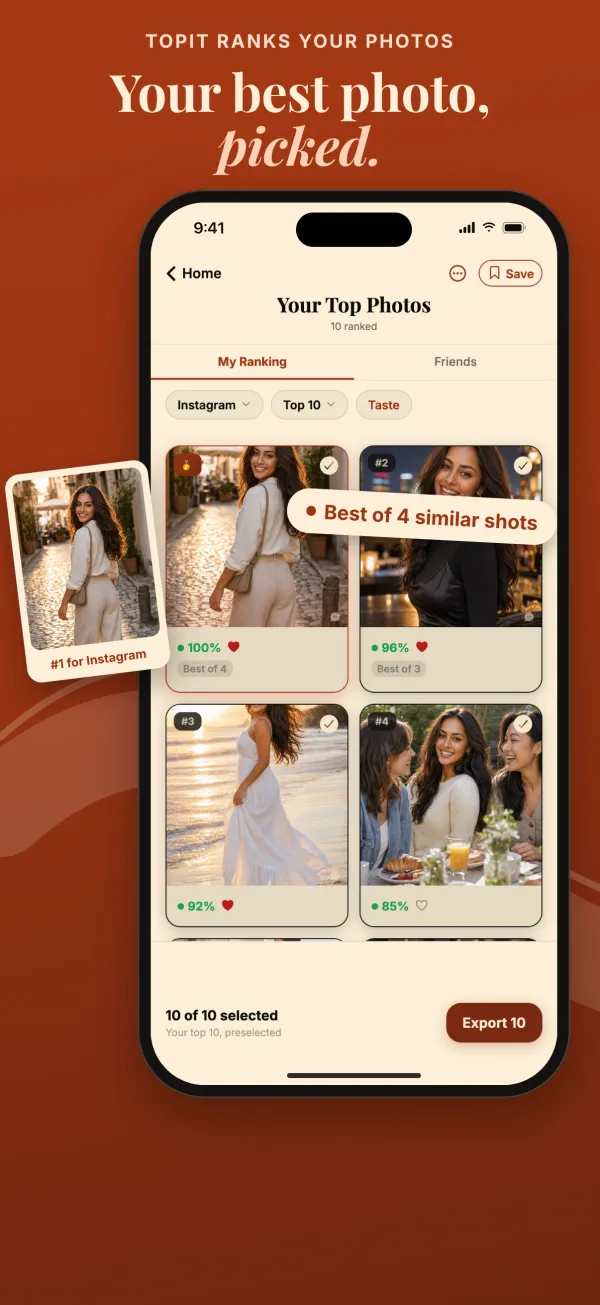

- Ranks the whole set. Upload a batch from your camera roll and get it back in order, with burst shots and near-duplicates collapsed to the strongest one.
- Ranks for the destination. The same photos come back in a different order for each place: dating puts the person and their expression first, LinkedIn a clear face, Instagram composition.
- Learns your taste. A few quick this-or-that comparisons build a profile of what you like, and the ranking leans toward it.
- Explains every pick. Each top photo comes with a reason. Disagree, tell it what you want (more candid, less posed), and it reranks.
- Lets friends vote. Send a shortlist by link. Friends vote without an account, can choose to stay anonymous, and you see who picked what.
Free to try, no credit card. Paid plans, Pro ($4.99/month) and Creator ($14.99/month), are sold in the iPhone app and raise the limits on photos and projects. Only the photos you choose are uploaded, they are kept until you delete the project or your account, and Topit does not sell personal information. Details in the privacy policy.
Sources
- Epley and Whitchurch (2008), "Mirror, mirror on the wall: enhancement in self-recognition", Personality and Social Psychology Bulletin 34(9). pubmed.ncbi.nlm.nih.gov/18550861
- White, Sutherland and Burton (2017), "Choosing face: the curse of self in profile image selection", Cognitive Research: Principles and Implications 2:23. A 2021 correction left the self versus other result standing. pmc.ncbi.nlm.nih.gov/articles/PMC5391387