 Topit
Dating
Best Photos for Hinge: A Checklist for Every Photo You Upload
The first photo gets most of the attention. The rest still get read, and any one of them can be the thing someone replies to. Here is how to check each photo before it goes up.
The short answer
The best Hinge photos are recent, mostly solo, clearly lit, and each one gives a stranger something specific to say. Hinge asks for four to six photos depending on where you live1. People can react to a single photo, so make each one able to start a conversation rather than filler. Lead with your clearest face, cut duplicates and anything that hides you, and let Hinge's Top Photo test which one goes first.2
Our guide to which photo to use first on Hinge covers the lead photo and the job each slot should do. This one is the check you run on every photo before it goes up, and the list of what to cut.
photos are required on a Hinge profile, depending on local rules, plus three prompt answers.
Hinge Help Center1more likely to get a like: women smiling with teeth versus without. Men did better smiling without teeth.
Hinge data via Business Insider3Five questions for every photo
Is it recent? If you have changed your hair, your glasses or your build since it was taken, it goes. Hinge's own refresh advice is to drop outdated photos.4 The test is simple: would someone recognise you from it walking into the bar?
Can someone see your face? Sunglasses, a cap pulled low, a photo from forty feet away or a crowd you are lost in all hide the thing a dating photo is for. One of these is fine late in the set. Two is a pattern.
Is it different from every other photo you picked? Same night, same shirt, same angle means the same photo, however much better the second one looks to you. Six slots that repeat each other are one photo with five copies.
Could someone start a conversation with it? Any single photo can be the one someone reacts to, so a photo that gives nobody anything to say is doing half its job. You at a bar says you go to bars. You losing badly at a pub quiz, holding a fish you are clearly scared of, or halfway up a climbing wall gives someone a first line.
Would you be happy if this were the one they replied to? The photo someone comments on decides what the first conversation is about. If a photo would start a conversation you do not want, it is the wrong photo even if you look great in it.
What to cut first
| Photo | Why it goes | Replace it with |
|---|---|---|
| A second group photo | People stop working out which one is you, and Hinge advises against more than one4 | A solo photo of you doing something |
| Gym or bathroom mirror selfie | Hinge advises against it4, and it says less than you think | A full-length photo someone else took |
| Arm's-length selfie as the lead | At about 12 inches a phone makes the nose look around 30% larger than from five feet6 | The same light, on a timer, from further back |
| Anything that hides your face early | Hinge's advice is to skip photos that hide your face4 | The same place, glasses off |
| A photo with someone cropped out | The stray shoulder tells a story you have not chosen to tell | A solo shot from the same day, if there is one |
| The near-duplicate | It takes a slot and says nothing new | Whatever job your set is missing |
Smile or not?
Hinge's own analysis found the effect of a smile depends on gender: women smiling with teeth were 76% more likely to get a like than women smiling without, and men smiling without teeth were 43% more likely to get a like.3 The more useful reading of that data is that an expression you actually make beats one you are holding for the camera. If you are choosing between a held grin and a real half-smile, take the real one.
The order after the first photo
Hinge's Top Photo predicts which photo is most likely to get a like and puts that one first.2 It does not arrange the rest, and it can only choose among what you uploaded. Two rules cover most of the ordering:
- Put a full-length photo early. Leaving it to slot six reads as an afterthought, and leaving it out reads as hiding something.
- Never put two of the same kind next to each other. Two similar photos in a row read as one photo twice. Alternate close and wide, solo and social, still and doing something.
When two photos are both good
This is where most people stall, and it is where you are least reliable. In a study of profile photo choice, photos chosen by strangers made better first impressions than the ones people picked of themselves.5 You remember what was happening when the photo was taken. A stranger only sees the frame.
So compare the two side by side, not one at a time, and ask someone who does not know you well which one they would reply to. Our guide to getting honest feedback on your photos covers how to ask so the answer is useful.
Frequently asked questions
How many photos should I put on Hinge?
Hinge requires four to six, depending on local rules.1 Fill six if you have six that each do something different. Five strong, varied photos beat six where two repeat.
Does every photo on my Hinge profile matter?
Yes. People can react to a single photo, not just the first one, so make each photo able to start a conversation.
Should I turn on Hinge Top Photo?
It is worth it. It uses a machine learning model to put the photo most likely to get a like first.2 It only reorders, so choosing a varied set is still your job.
How often should I change my Hinge photos?
Whenever they stop looking like you would on a first date. There is no official schedule; Hinge's own advice is simply to drop outdated photos.4
How Topit does it
Choosing Hinge photos with Topit
Topit is a photo selector app. Upload a batch of photos, pick where they are going (a dating app, Instagram or LinkedIn), and Topit ranks the whole set for that destination, learns your taste as you compare, and explains every pick. Free to try on iPhone, Android and the web.
The problem
Hinge can reorder the photos you upload, but it cannot tell you which ones to upload out of the hundreds in your camera roll, and you are a biased judge of your own face.
How Topit solves it
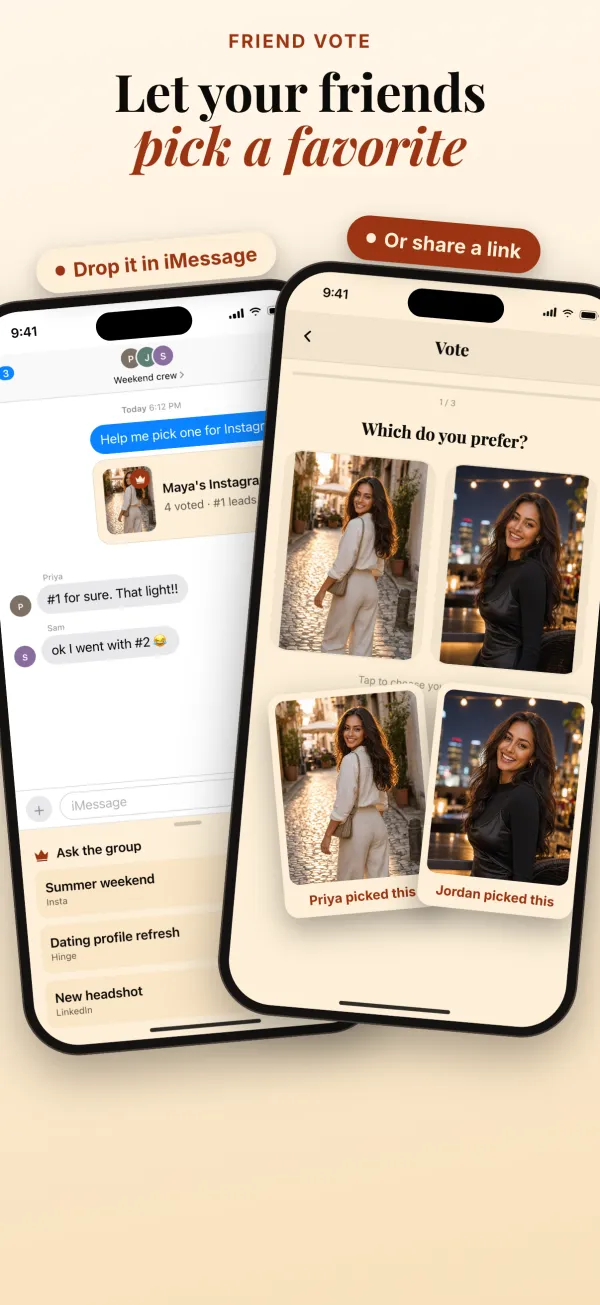
Upload a batch, choose dating, and Topit ranks the whole set for it. It collapses near-identical shots to the strongest one, so the six you keep are six different photos, and every top pick comes with a reason you can disagree with. Not sure between two? Send the shortlist to friends and see who picked what.
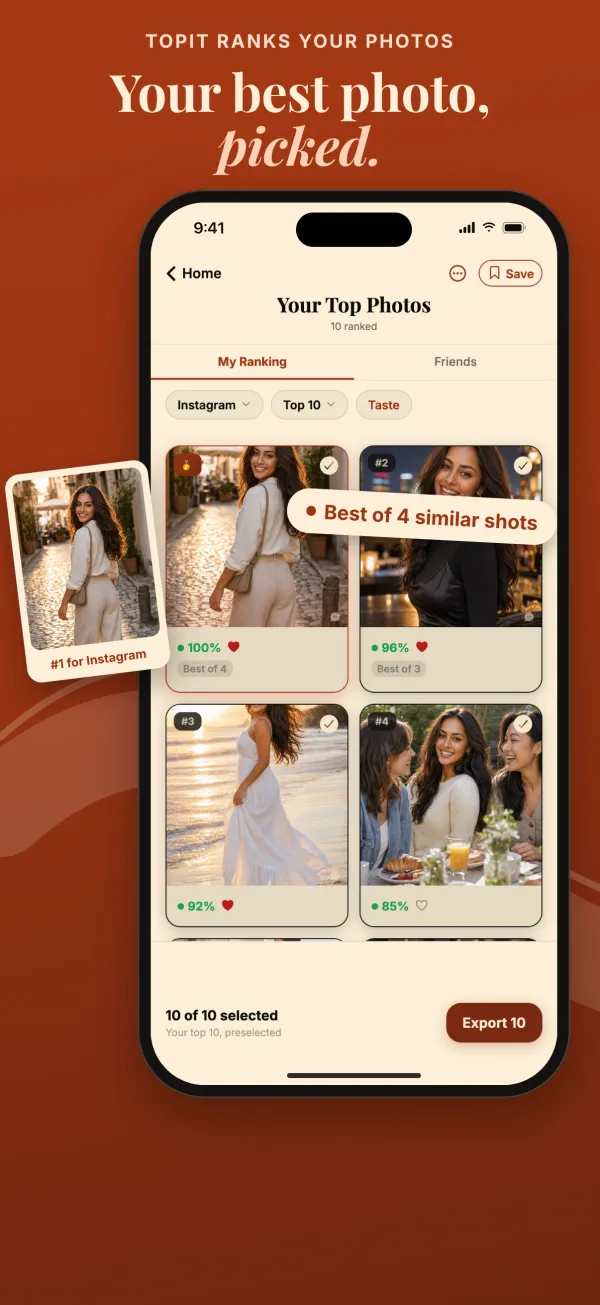
- Ranks the whole set. Upload a batch from your camera roll and get it back in order, with burst shots and near-duplicates collapsed to the strongest one.
- Ranks for the destination. The same photos come back in a different order for each place: dating puts the person and their expression first, LinkedIn a clear face, Instagram composition.
- Learns your taste. A few quick this-or-that comparisons build a profile of what you like, and the ranking leans toward it.
- Explains every pick. Each top photo comes with a reason. Disagree, tell it what you want (more candid, less posed), and it reranks.
- Lets friends vote. Send a shortlist by link. Friends vote without an account, can choose to stay anonymous, and you see who picked what.
Free to try, no credit card. Paid plans, Pro ($4.99/month) and Creator ($14.99/month), are sold in the iPhone app and raise the limits on photos and projects. Only the photos you choose are uploaded, they are kept until you delete the project or your account, and Topit does not sell personal information. Details in the privacy policy.
Sources
- Hinge Help Center, "How do I edit my profile?" (four to six photos depending on local requirements). help.hinge.co/hc/en-us/articles/360011053094-How-do-I-edit-my-profile
- Hinge Help Center, "What is Top Photo?". help.hinge.co/hc/en-us/articles/26558052212627-What-is-Top-Photo
- Business Insider (2017), reporting Hinge's analysis of which profile photos get likes. www.businessinsider.com/profile-picture-tips-for-online-dating-according-to-hinge-2017-4
- Hinge Newsroom, profile refresh guide. hinge.co/newsroom/profile-refresh-guide
- White, Sutherland and Burton (2017), "Choosing face: the curse of self in profile image selection", Cognitive Research: Principles and Implications 2:23. A 2021 correction left the self versus other result standing. pmc.ncbi.nlm.nih.gov/articles/PMC5391387
- Ward et al. (2018), "Nasal distortion in short-distance photographs: the selfie effect", JAMA Facial Plastic Surgery 20(4). pmc.ncbi.nlm.nih.gov/articles/PMC5876805