 Topit
Feedback
How to Get Honest Feedback on Your Photos
Ask a friend whether a photo is good and they will say yes. That is not dishonesty; it is how the question was asked. Here is how to ask so the answer is worth having.
The short answer
Ask which, not whether: show two to six photos and ask which one, for a specific place. Collect everyone's answer separately before anyone sees anyone else's, because seeing other answers narrows opinions without making them more accurate.3 Let people answer anonymously. And include people who do not know you well, because strangers choose better photos of us than we do.1
Most bad photo feedback is not a problem with the people you asked. It is a problem with the question, and with the order they saw each other's answers in.
Why you are not getting honest answers
The question invites a yes. Is this a good photo of me? has one polite answer. Almost nobody gives the other one to a friend.
Your friends know you. They pick the photo that looks most like the person they know, which is not the same as the photo that works on someone who has never met you.
You are not neutral either. People recognise their own face as more attractive than it is and prefer flattering versions of themselves.2 In a study of profile photos, images chosen by strangers made better first impressions than the ones people chose of themselves.1 So feedback that agrees with you is the least informative kind.
Ask which, not whether
A comparison is easier to answer honestly than a rating, because choosing one photo is not the same as calling the other bad. Ask which, not whether, and name where the photo is going:
| Instead of | Ask |
|---|---|
| Is this a good photo? | Which of these three would you swipe right on? |
| Do I look okay here? | Which of these looks most like me on a normal day? |
| Should I use this for LinkedIn? | Which of these would you trust to run a meeting? |
| Which is best? (with 30 photos) | Here are my top five. Pick one, and say why in a few words. |
Keep the set small. Two to six photos gets a considered answer. Thirty gets whichever one they happened to look at last.
Keep the votes independent
If you post the photos in a group chat, the first reply sets the answer. Everyone after is reacting to it. Researchers who studied this found that once people saw others' estimates, their answers converged without getting more accurate, and they became more confident anyway.3 That is exactly what happens in a group chat: a fast consensus that feels certain and tells you one person's opinion.
Ask people one at a time, or use a tool that hides the results until everyone has voted. Then look at the totals.
Let people answer anonymously
Someone who would never say your favourite photo looks off to your face will happily skip it in an anonymous vote. If you want the truth, remove the social cost of telling it.
Ask the right people
- Someone who does not know you well. A colleague, a friend of a friend, someone you met last month. They are closer to the audience you are choosing for.
- People who match the audience. For a dating photo, people who would plausibly see your profile. For a work photo, people in your field.
- Strangers. Crowd-rating sites have strangers rate one photo at a time, which is the purest outside read and slow for many photos. Our comparison of photo feedback tools covers the options.
Reading the results
Count first, then read the reasons. Votes tell you which photo; reasons tell you what to fix in the others. One passionate opinion is still one vote.
A close result is an answer. If two photos split the vote, both work. Choose the one that fits the rest of your set better, and stop asking.
A clear loser is the most useful result. If nobody picked your favourite, that is the bias the research describes, showing up on schedule.1
Frequently asked questions
Should I ask my partner or best friend?
Ask them, and count them as one vote. They know you best, which makes them the furthest from a stranger's first impression.
How many people should I ask?
A handful of independent answers is usually more useful than one long conversation. Stop when new answers stop changing the result.
Are photo-rating sites accurate?
They give you how strangers read one photo at a time, which is a real signal. They are slower when the question is which of many.
How do I get a group to agree on a group photo?
See our guide to picking the best group photo: shortlist first, then let each person veto.
How Topit does it
Getting honest votes with Topit
Topit is a photo selector app. Upload a batch of photos, pick where they are going (a dating app, Instagram or LinkedIn), and Topit ranks the whole set for that destination, learns your taste as you compare, and explains every pick. Free to try on iPhone, Android and the web.
The problem
Asking in a group chat gets you the first person's opinion, repeated. Asking one by one is slow, and nobody wants to tell you a photo is bad with their name on it.
How Topit solves it
Make a Group Vote from your top photos and share the link. Friends vote without an account: with seven or more photos they heart the ones they like, then rank their top three. Each voter can choose to be anonymous, and by default results stay hidden until the vote closes, so nobody anchors on anyone else. You get the group's pick, who chose what, and the reasons they tapped.
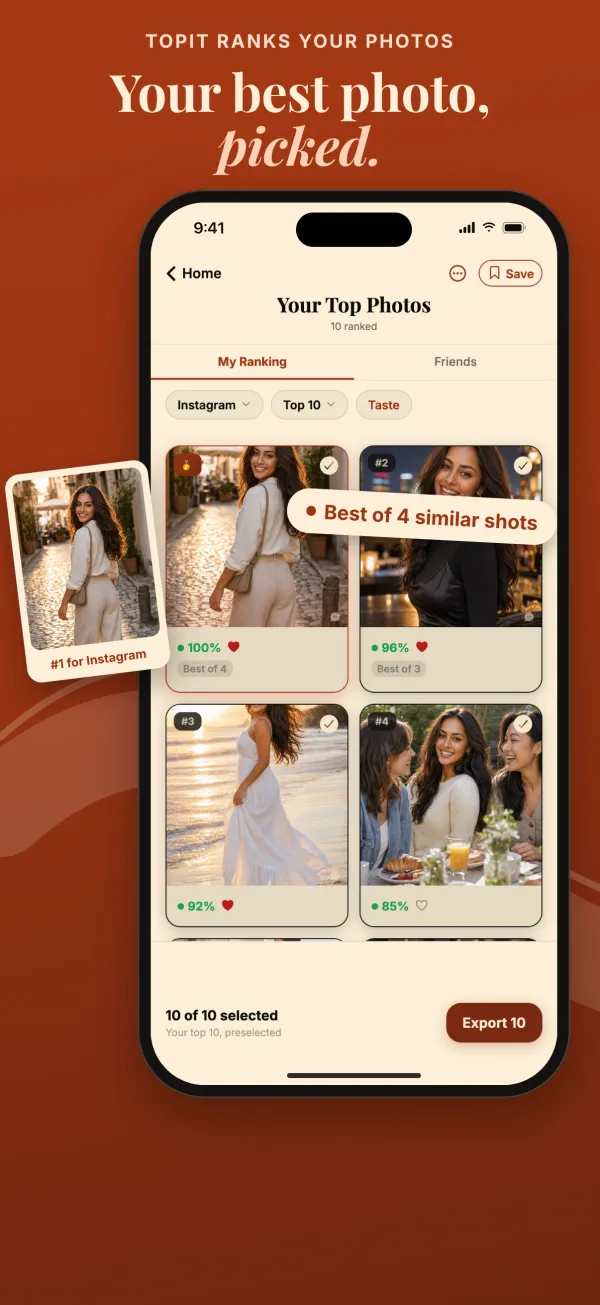

- Ranks the whole set. Upload a batch from your camera roll and get it back in order, with burst shots and near-duplicates collapsed to the strongest one.
- Ranks for the destination. The same photos come back in a different order for each place: dating puts the person and their expression first, LinkedIn a clear face, Instagram composition.
- Learns your taste. A few quick this-or-that comparisons build a profile of what you like, and the ranking leans toward it.
- Explains every pick. Each top photo comes with a reason. Disagree, tell it what you want (more candid, less posed), and it reranks.
- Lets friends vote. Send a shortlist by link. Friends vote without an account, can choose to stay anonymous, and you see who picked what.
Free to try, no credit card. Paid plans, Pro ($4.99/month) and Creator ($14.99/month), are sold in the iPhone app and raise the limits on photos and projects. Only the photos you choose are uploaded, they are kept until you delete the project or your account, and Topit does not sell personal information. Details in the privacy policy.
Sources
- White, Sutherland and Burton (2017), "Choosing face: the curse of self in profile image selection", Cognitive Research: Principles and Implications 2:23. A 2021 correction left the self versus other result standing. pmc.ncbi.nlm.nih.gov/articles/PMC5391387
- Epley and Whitchurch (2008), "Mirror, mirror on the wall: enhancement in self-recognition", Personality and Social Psychology Bulletin 34(9). pubmed.ncbi.nlm.nih.gov/18550861
- Lorenz, Rauhut, Schweitzer and Helbing (2011), "How social influence can undermine the wisdom of crowd effect", Proceedings of the National Academy of Sciences 108(22). pubmed.ncbi.nlm.nih.gov/21576485