 Topit
Which Photo Should You Post on Instagram?
This is a different question from how to grow on Instagram, and the two get tangled constantly. Growth is about hooks, timing and consistency. This page is about the smaller and much more common problem: you took forty photos, six of them are good, and you have to pick.
The short answer
Cut the near-duplicates to one per moment, then compare the survivors two at a time. Prefer the frame that looks least posed over the one where you look most composed, check it still works in the 3:4 grid crop, and post it at 4:5 (1080 by 1350). If you cannot get down to one, post a carousel: carousels average higher engagement than single images.4
portrait, 1080 by 1350 pixels, takes up the most feed space for a photo.
Buffer; Instagram Help Center21is the crop your profile grid shows since Instagram moved to a taller grid in January 2025.
Adam Mosseri; Buffer32average engagement for carousels in 2025, against 0.37% for single images.
Socialinsider, about 35M posts4Why picking between similar photos is genuinely hard
When you took forty photos of one thing, the differences between the best six are tiny. A slightly different expression. A hand in a marginally better position. Eyes open in one and half-closed in another.
You are not bad at this. The comparison is just hard, and it gets harder the more times you look at them. After the fifth pass through the same six photos, they all start to look the same and you pick whichever one you happened to look at last. Research on choice overload finds this is worst exactly when options are complex, hard to tell apart, and you are not sure what you want.6
The fix is not more looking. It is a different way of comparing.
A better way to compare
- Group by moment and keep one of each. Burst shots and near-identical frames go first. Keep the sharpest one with eyes open.
- Compare in pairs. Put two side by side and keep the better one. Pairs are a small decision; a grid of forty is not.
- Judge at feed size. Nobody sees your photo full screen first. Look at it small, the way it arrives in a scroll.
- Check the grid crop. Your profile grid shows a 3:4 crop2, so a 4:5 post loses a strip from each side in the grid. A subject near the left or right edge can disappear there even if the post looks fine.
- Ask one person who is not in the photo. People choose better photos of others than of themselves.7
Pick the one that looks least posed, not the one that looks best
The photo where you look most composed is usually the one where you look most aware of the camera. On a feed full of the same, the slightly unguarded one stands out.
This is why the photo taken half a second before or after the one you were going for is often the better post. Worth scrolling back a frame.
What size and shape to post
Instagram keeps photos at up to 1080 pixels wide, and keeps your original aspect ratio as long as it falls between 1.91:1 (landscape) and 3:4 (portrait); anything outside that is cropped.1 For most photos, 4:5 portrait at 1080 by 1350 is the practical choice because it fills more of the screen.2 Since January 2025 the profile grid also shows taller 3:4 previews32, so keep the subject centred.
Single photo or carousel?
If you have two or three photos that each do something different, post them together. Carousels averaged 0.55% engagement in 2025 against 0.37% for single images4, and Adam Mosseri has said carousels "often get more reach than single photo posts."5
For carousels, order matters more than the individual photos. The first image decides whether anyone swipes. The most common carousel mistake is leading with the most beautiful photo and following it with five that are almost identical to it. Vary what each image is doing. The full method is in our guide to Instagram carousel order.
Frequently asked questions
Which photo gets the most likes on Instagram?
There is no universal answer, and anyone who gives one is guessing about your audience. What holds across accounts: a clear subject, good light, a crop that survives the grid, and a photo that fits the rest of your feed.
What is the best Instagram photo size?
1080 by 1350 pixels at 4:5 for portrait posts.2 Instagram accepts ratios between 1.91:1 and 3:4 without cropping.1
How do I choose between two almost identical photos?
Look at them side by side at feed size and check three things: eyes, hands, and the edges of the frame. If they still tie, pick the less posed one.
Is there an app that picks the best photo for Instagram?
Yes. See our Instagram photo picker guide and our comparison of AI photo selector apps.
How Topit does it
Picking Instagram photos with Topit
Topit is a photo selector app. Upload a batch of photos, pick where they are going (a dating app, Instagram or LinkedIn), and Topit ranks the whole set for that destination, learns your taste as you compare, and explains every pick. Free to try on iPhone, Android and the web.
The problem
Forty frames of one moment, six good ones, and every pass through them makes the differences harder to see. A ranking built on some average of what performs is not much use if your feed does not look like that average.
How Topit solves it
Topit is built for exactly this problem. You feed it the batch, it ranks for Instagram specifically, where composition and visual appeal come first, and it tells you why each photo placed where it did. The near-identical problem is handled directly: the selection limits how many very similar shots make the final set. It learns your taste rather than applying a generic standard, which matters here more than anywhere, because Instagram is where personal aesthetic actually shows. And you can talk to it: ask for more candid, less staged, more colour, and it reranks against what you said.
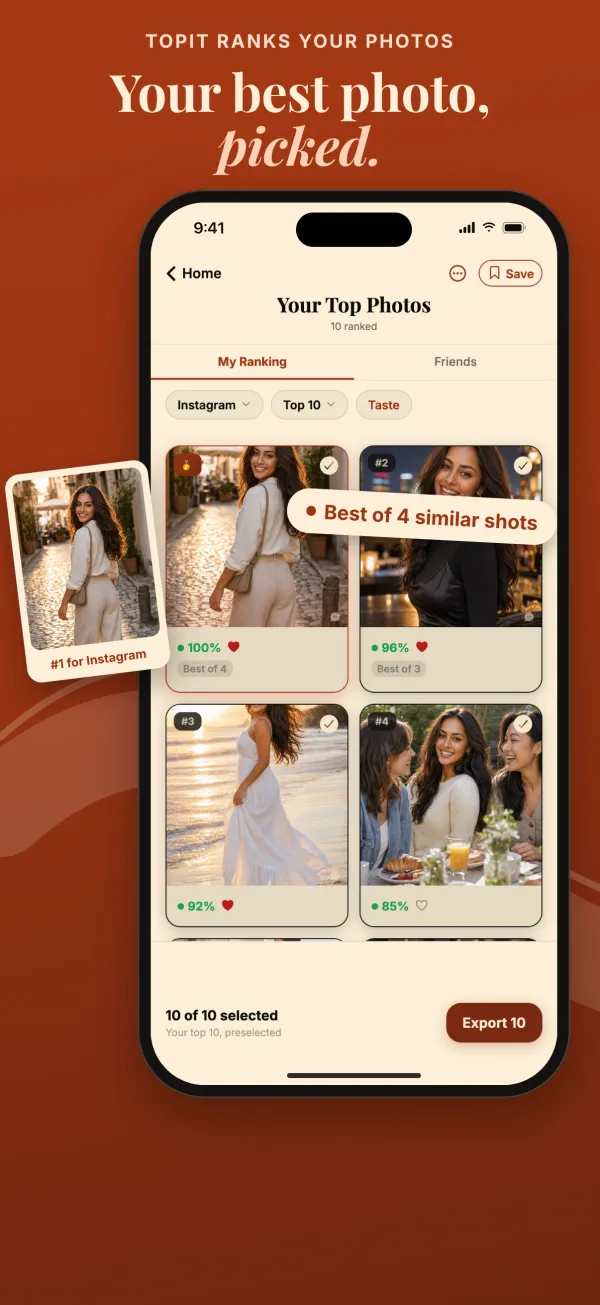
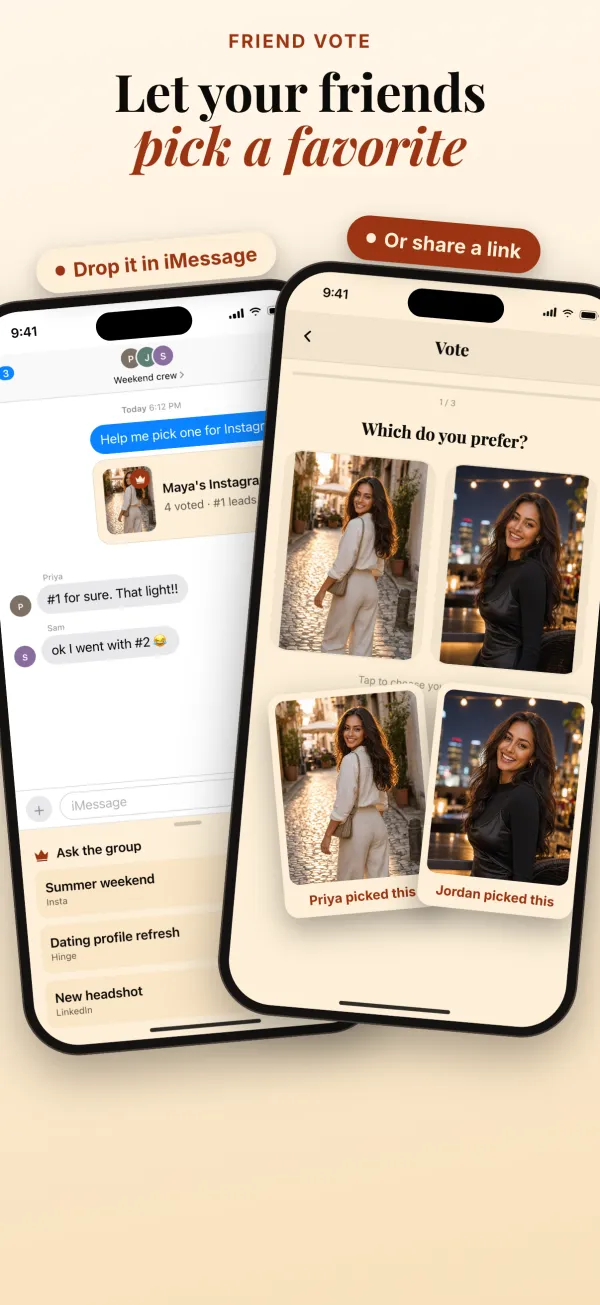
- Ranks the whole set. Upload a batch from your camera roll and get it back in order, with burst shots and near-duplicates collapsed to the strongest one.
- Ranks for the destination. The same photos come back in a different order for each app: dating puts the person and their expression first, LinkedIn a clear face, Instagram composition.
- Learns your taste. A few quick this-or-that comparisons build a profile of what you like, and the ranking leans toward it.
- Explains every pick. Each top photo comes with a reason. Disagree, tell it what you want (more candid, less posed), and it reranks.
- Lets friends vote. Send a shortlist to people you trust and see their picks next to yours.
Free to try, no credit card. Paid plans, Pro ($4.99/month) and Creator ($14.99/month), are sold in the iPhone app and raise the limits on photos and projects. Only the photos you choose are uploaded, they are kept until you delete the project or your account, and Topit does not sell personal information. Details in the privacy policy.
Sources
- Instagram Help Center, photo resolution and aspect ratios. help.instagram.com/1631821640426723
- Buffer, Instagram image size guide (1080 x 1350, 4:5 portrait). buffer.com/resources/instagram-image-size
- Adam Mosseri on Threads (January 2025), announcing the taller profile grid. www.threads.com/@mosseri/post/DFBmq7ySDvi
- Socialinsider, Instagram benchmarks (2025 organic engagement rate by format, about 35 million posts). www.socialinsider.io/social-media-benchmarks/instagram
- Adam Mosseri on Instagram (October 2024): "Carousels often get more reach than single photo posts". www.instagram.com/p/DBOeUmTSmIC
- Chernev, Bockenholt and Goodman (2015), "Choice overload: a conceptual review and meta-analysis", Journal of Consumer Psychology 25(2). www.sciencedirect.com/science/article/pii/S1057740814000916
- White, Sutherland and Burton (2017), "Choosing face: the curse of self in profile image selection", Cognitive Research: Principles and Implications 2:23. A 2021 correction left the self versus other result standing. pmc.ncbi.nlm.nih.gov/articles/PMC5391387