 Topit
Dating
Which Photos Should You Use on Your Dating Profile?
Your best photo and your best dating photo are rarely the same picture. Here is how to pick a lineup that works, what the data says, and why the photo you like most is usually not the one to lead with.
The short answer
Lead with a recent solo photo where your face is clear, in daylight or window light, with an expression you actually make. Give every other slot a different job: full length, doing something, one group photo, something with personality. Cut near-duplicates. And let someone who does not know you well help choose, because research shows strangers pick better photos of you than you do.1
Most people pick their dating photos the same way. Scroll the camera roll, find the four or five they like best, upload those. It feels obvious. It is also why so many profiles are five variations of the same photo.
The problem is that you are not choosing photos. You are choosing a lineup, and a lineup has requirements a single photo does not.
is all it takes for someone to form an impression of a face, and more time mostly adds confidence, not a different verdict.
Willis and Todorov, 20062of singles aged 18 to 25 say choosing a profile photo is hard. 18 to 24 year olds spend 33 minutes on it.
Tinder and Opinium, 20244more likely to match with women: Tinder's figure for men who include more than one photo showing their face.
Tinder internal data, 20244What should your first dating photo be?
The photo you like most is usually the one you look best in. That is not the same as the one that works hardest.
A first photo has one job: someone should be able to tell what you look like. Clear face, decent light, you are the only person in it, and recent enough that meeting you is not a surprise. That sounds like a low bar, but a surprising number of profiles lead with a group shot, a photo from forty feet away, or something taken in a bar at midnight.
Light matters more than the camera. Daylight from the side or a window in front of you flatters almost everyone; overhead indoor light and flash at night flatter almost no one. And be careful with arm's-length selfies: at about 12 inches, a phone camera makes the nose look around 30% larger than it does from five feet away.9 Ask someone to take it, or prop the phone up and use the timer from further back.
Save the flattering-but-ambiguous ones for later slots. They work better there.
Five photos, five different jobs
The strongest profiles cover different ground rather than repeating the same note:
- A clear face shot. Solo, well lit, recent. This is the one that has to work.
- A full-length shot. Leaving this out reads as hiding something, whether or not you meant it that way.
- Something you actually do. Cooking, climbing, playing something. It gives someone a specific thing to open with, which is worth more than another good-looking photo.
- Something with other people. One group photo, not four. It shows you have a life. More than one and people stop trying to work out which person is you. Hinge's own advice says the same: pass on more than one group photo.11
- Something with a bit of personality. Slightly odd, slightly funny, slightly specific. It is usually the one people mention.
Miss one of those and the profile reads flat even if every individual photo is good. App by app: Tinder, Bumble and Hinge. Most apps give you room for more: Hinge asks for four to six photos depending on where you live.10
The mistake almost everyone makes
Near-duplicates. Four photos from the same night, same shirt, same lighting, same angle. Each one is fine. Together they use four of your five slots to say one thing.
This is hard to catch yourself, because you are comparing photos one at a time and the second one really does look slightly better than the first. You only see the problem when you look at all five together, which is exactly the moment you have stopped looking.
Should you smile in dating photos?
The data disagrees, which is itself the useful finding. Hinge's 2017 analysis found women smiling with teeth were 76% more likely to get a like than women smiling without, while men smiling without teeth were 43% more likely to get a like.5 OkCupid's 2010 analysis of 7,140 photos suggested men did better looking away and not smiling6, and a later replication by Photofeeler found smiling made no statistically significant difference for men.7 Photofeeler's study of 60,000 ratings did find a smile with teeth raised likability, and sunglasses lowered it.8
The consistent part: an expression that is yours beats one you are holding for the camera. If you have to choose between a held smile and a real half-smile, take the real one, and keep your eyes visible.
Why you are the wrong judge of your own photos
You know what was happening when each photo was taken. You remember the joke, the weather, how you felt about your hair that week. A stranger sees only the frame.
Two lines of research back this up. People recognize their own face as more attractive than it is, picking flattering edited versions of themselves as the real one.3 And in a study of profile photo selection, photos chosen by strangers created better first impressions than the photos people picked of themselves.1 The authors' practical advice was blunt: if you want to put your best face forward, ask someone else to choose it.
Why asking friends only half works
Friends are useful and they are also biased in a specific direction. They pick the photo that looks most like the version of you they know, which is not the same as the photo that works on someone who has never met you. Someone you met last month is closer to your real audience than your oldest friend.
Their picks are still worth having. Just treat them as one input rather than the answer.
Frequently asked questions
How many photos should a dating profile have?
Fill the slots the app gives you, as long as each photo does a different job. Hinge asks for four to six.10 Five or six varied photos beat six versions of one evening.
Are selfies okay on a dating profile?
One is fine. Close-range selfies distort your face, so do not lead with one, and avoid bathroom-mirror and gym selfies, which Hinge itself advises against.11
Should my first photo be a group photo?
No. The first photo has to answer what you look like, and a group photo makes people work out which one you are.
Can an app choose my dating photos for me?
Yes. Set rankers such as Topit rank a batch of photos for dating specifically and flag near-duplicates. See our comparison of AI photo selector apps.
How Topit does it
Picking a dating lineup with Topit
Topit is a photo selector app. Upload a batch of photos, pick where they are going (a dating app, Instagram or LinkedIn), and Topit ranks the whole set for that destination, learns your taste as you compare, and explains every pick. Free to try on iPhone, Android and the web.
The problem
You have dozens of photos from the last year, a dating app wants about six, and you are the person least able to judge them. Comparing them one at a time lets near-duplicates win over and over.
How Topit solves it
Topit ranks your batch for dating specifically, where the person and their expression count most, so the same photos come back in a different order than they would for LinkedIn. It builds the selection as a lineup rather than a leaderboard, capping near-identical shots and limiting how many photos of the same type land in one set. You choose which photos to upload, every top pick comes with a reason, and you can swap a pick out or tell Topit what you want instead and rerank.
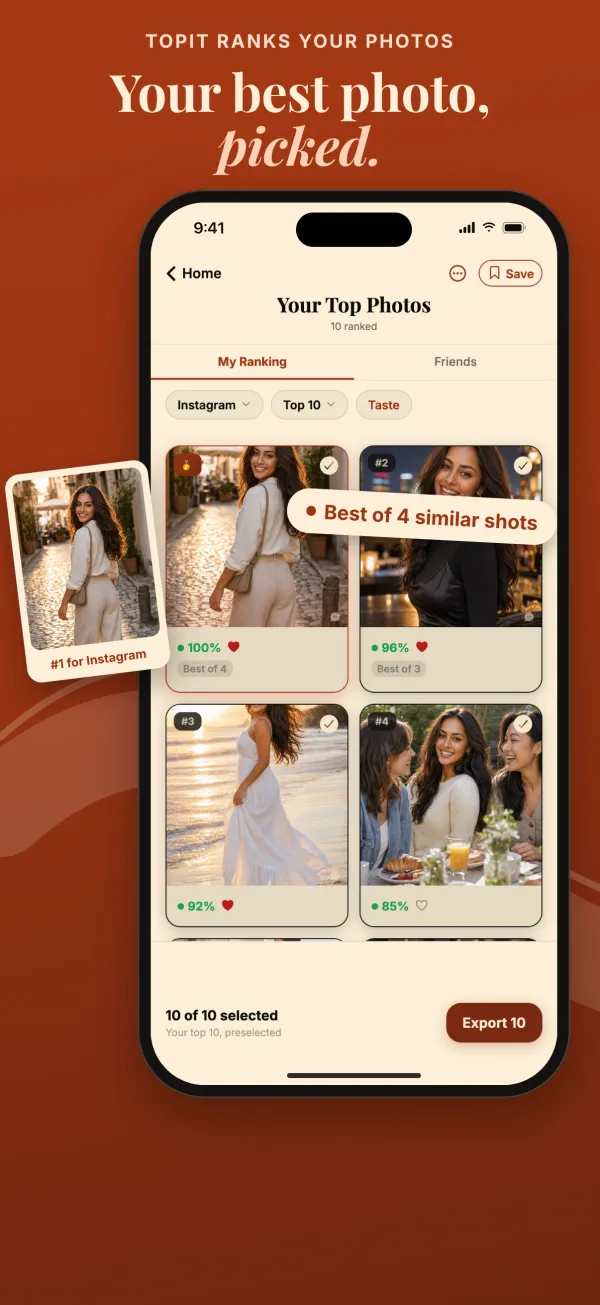
- Ranks the whole set. Upload a batch from your camera roll and get it back in order, with burst shots and near-duplicates collapsed to the strongest one.
- Ranks for the destination. The same photos come back in a different order for each app: dating puts the person and their expression first, LinkedIn a clear face, Instagram composition.
- Learns your taste. A few quick this-or-that comparisons build a profile of what you like, and the ranking leans toward it.
- Explains every pick. Each top photo comes with a reason. Disagree, tell it what you want (more candid, less posed), and it reranks.
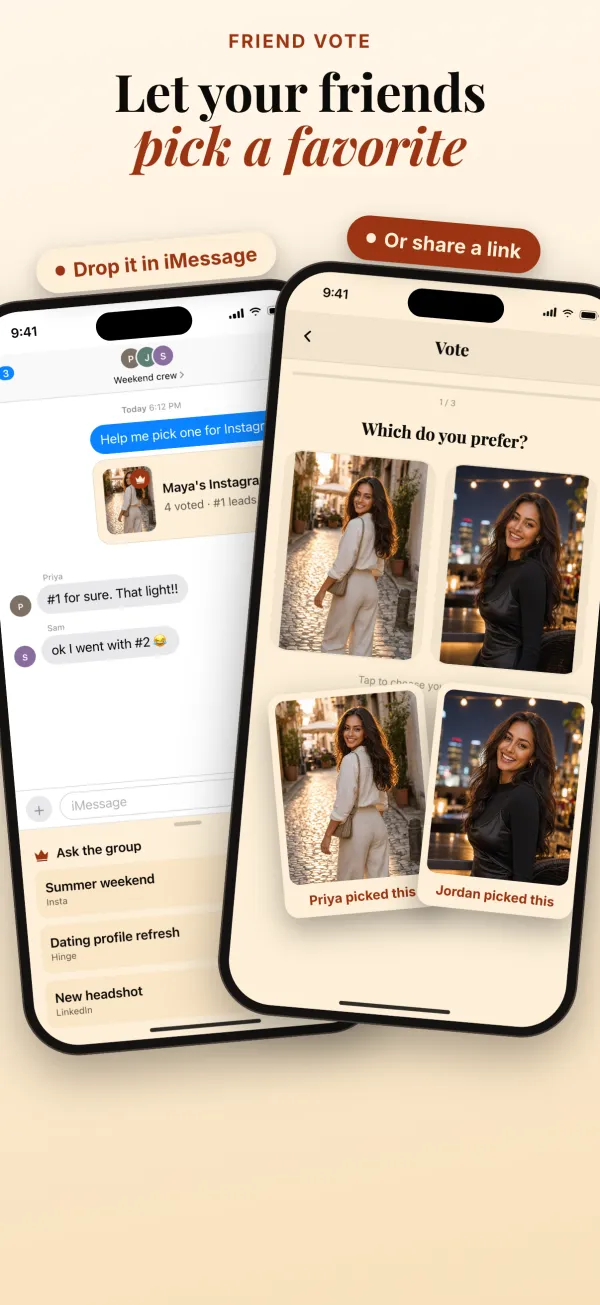
- Lets friends vote. Send a shortlist to people you trust and see their picks next to yours.
Free to try, no credit card. Paid plans, Pro ($4.99/month) and Creator ($14.99/month), are sold in the iPhone app and raise the limits on photos and projects. Only the photos you choose are uploaded, they are kept until you delete the project or your account, and Topit does not sell personal information. Details in the privacy policy.
Sources
- White, Sutherland and Burton (2017), "Choosing face: the curse of self in profile image selection", Cognitive Research: Principles and Implications 2:23. A 2021 correction left the self versus other result standing. pmc.ncbi.nlm.nih.gov/articles/PMC5391387
- Willis and Todorov (2006), "First impressions: making up your mind after a 100-ms exposure to a face", Psychological Science 17(7). pubmed.ncbi.nlm.nih.gov/16866745
- Epley and Whitchurch (2008), "Mirror, mirror on the wall: enhancement in self-recognition", Personality and Social Psychology Bulletin 34(9). pubmed.ncbi.nlm.nih.gov/18550861
- Tinder press release (July 17, 2024) on Photo Selector, citing an Opinium survey of 7,000 singles aged 18 to 25 in seven countries. www.tinderpressroom.com/Tinder-R-Unveils-Photo-Selector-AI-Feature-to-Make-Choosing-Profile-Pictures-Easier
- Business Insider (2017), reporting Hinge's analysis of which profile photos get likes. www.businessinsider.com/profile-picture-tips-for-online-dating-according-to-hinge-2017-4
- Christian Rudder, OkTrends (2010), "The 4 big myths of profile pictures" (archived copy). gwern.net/doc/psychology/okcupid/the4bigmythsofprofilepictures.html
- Photofeeler blog, replication of the OkCupid smiling and eye-contact analysis for men's photos. blog.photofeeler.com/okcupid-is-wrong-about-smiling-eye-contact-mens-dating-profile-photos
- Photofeeler blog, analysis of 60,000+ ratings of 800 profile photos (vendor study, not peer reviewed). blog.photofeeler.com/perfect-photo
- Ward et al. (2018), "Nasal distortion in short-distance photographs: the selfie effect", JAMA Facial Plastic Surgery 20(4). pmc.ncbi.nlm.nih.gov/articles/PMC5876805
- Hinge Help Center, "How do I edit my profile?" (four to six photos depending on local requirements). help.hinge.co/hc/en-us/articles/360011053094-How-do-I-edit-my-profile
- Hinge Newsroom, profile refresh guide. hinge.co/newsroom/profile-refresh-guide