 Topit
Dating
Which Photo Should You Use on Hinge?
People see your photos one at a time as they read your profile, and the first one does most of the work. Here is how to choose it, and how to give the rest of your slots something different to say.
The short answer
Lead with a solo photo where someone can tell what you look like within a second: your face clear, taken in daylight or by a window, with the expression you make when nobody is pointing a camera at you. Hinge asks for four to six photos depending on where you live1, and each of the others should answer a different question. If you are unsure which photo should go first, Hinge's Top Photo feature can test that for you.2
The mistake most Hinge profiles make is not a bad photo. It is six photos with the same job.
photos are required on a Hinge profile, depending on local rules, plus three prompt answers.
Hinge Help Center1more likely to get a like: women smiling with teeth versus without, in Hinge's 2017 photo analysis.
Hinge data via Business Insider3photo is "crucial to making a good first impression", which is why Hinge built a model to choose it.
Hinge Help Center2The four tests for a first photo
Can a stranger identify you? Solo, face visible, recent enough that meeting you is not a surprise. Sunglasses, a group, or a photo from across a field all fail this test, however good they look. Hinge's own advice is to skip outdated photos and anything that hides your face.4
Is the light doing you a favour? Daylight from the side, or a window in front of you. Overhead indoor light and flash at night are the two that flatter almost nobody.
Is the expression yours? A held smile reads as held. The photos people respond to are usually the ones where you were reacting to something rather than posing for it. Hinge's data found the effect of a smile differs by gender: women smiling with teeth did better, and men did better smiling without teeth.3
Does it look like a normal day? The first photo sets the register for the whole profile. A wedding suit or a formal headshot says something true about one afternoon and not much about the rest of your week.
People form a read on a face in about a tenth of a second7, so these four tests are about what someone sees before they have decided to look closely.
Six slots, six jobs
A Hinge profile reads best when each photo answers a different question:
| Slot | The question it answers | What works |
|---|---|---|
| 1 | What do you look like? | Solo, clear face, real light, recent |
| 2 | What do you look like at full length? | Standing, not cropped at the waist |
| 3 | What do you do? | Cooking, climbing, playing something: a thing to open with |
| 4 | Who are you with? | One group photo, where you are easy to find |
| 5 | Where do you go? | Somewhere you actually spend time |
| 6 | What is slightly odd about you? | The specific, funny one people mention |
One group photo, not three. Two and people stop trying to work out which one is you, and Hinge itself advises against more than one.4 Skip the gym selfie for the same reason Hinge does.4
Six slots that all say the same thing is one photo posted six times. A profile is not five good photos and a spare. It is a set, and the set is what gets read. Our checklist for every Hinge photo covers what to cut.
Does Hinge choose your first photo for you?
It can. Top Photo "uses a machine learning model to predict which of your profile photos is most likely to get you a Like and puts that photo first."2 That is worth turning on. It is also limited by what you give it: it can only reorder the photos you uploaded, so a set of six near-identical shots gets you the best of six near-identical shots. Choosing a varied set is still your job.
Why you are the wrong judge
You know what was happening when each photo was taken. You remember the joke, the weather, how you felt about your hair that week. A stranger sees only the frame. So the photo you like most is often the one attached to the best memory, and that is a different thing from the one that reads best cold.
Research on profile photos found exactly this: images chosen by strangers made better first impressions than the ones people picked of themselves.5 Comparing your own photos one at a time makes it worse. Each one gets judged against how you feel about it rather than against the others, and the near-duplicates from the same night all win the same argument.
Ways to get an outside read
Ask someone who does not know you well. A close friend picks the photo that looks most like the version of you they know. Someone you met last month is closer to the audience you are actually choosing for.
Crowd-voting sites. Strangers rate one photo at a time. Good for the narrow question of how a single shot reads to people who have never met you, and slow when you have thirty candidates.
Ranking tools. Give them the set and the destination, and get the set back in order. This answers the question most people actually have, which is not whether one photo is good but which of these, and in what order. Our comparison of photo selector apps covers the options.
Frequently asked questions
How many photos do you need on Hinge?
Four to six, depending on local requirements, along with three prompt answers.1
Should my first Hinge photo be a selfie?
Ideally not. Close-range phone selfies distort facial proportions, making the nose look about 30% larger at 12 inches than at five feet.6 A photo someone else took, or one on a timer from further back, reads more like you.
What is Hinge Top Photo?
A Hinge feature that uses a machine learning model to predict which of your photos is most likely to get a Like and puts it first.2
How Topit does it
Choosing Hinge photos with Topit
Topit is a photo selector app. Upload a batch of photos, pick where they are going (a dating app, Instagram or LinkedIn), and Topit ranks the whole set for that destination, learns your taste as you compare, and explains every pick. Free to try on iPhone, Android and the web.
The problem
Hinge can reorder the photos you upload, but it cannot tell you which six to upload out of the hundred in your camera roll, and you are a biased judge of your own face.
How Topit solves it
Topit learns your taste first, through a short set of side-by-side comparisons, then ranks your batch for dating specifically. It builds the selection as a lineup rather than a leaderboard: it caps how many near-identical shots make the cut and limits how many photos of the same type land in one set, so you do not end up with six versions of the same night. Every top pick comes with a reason, and you can swap a pick out or feed your reason back to rerank.
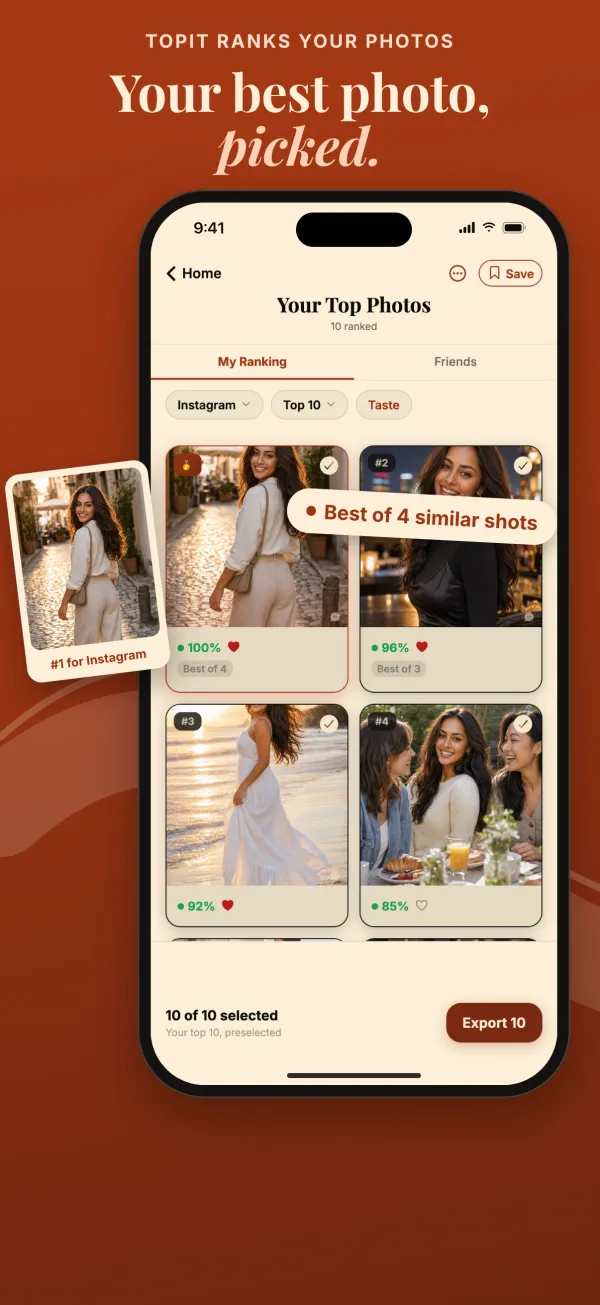
- Ranks the whole set. Upload a batch from your camera roll and get it back in order, with burst shots and near-duplicates collapsed to the strongest one.
- Ranks for the destination. The same photos come back in a different order for each app: dating puts the person and their expression first, LinkedIn a clear face, Instagram composition.
- Learns your taste. A few quick this-or-that comparisons build a profile of what you like, and the ranking leans toward it.
- Explains every pick. Each top photo comes with a reason. Disagree, tell it what you want (more candid, less posed), and it reranks.
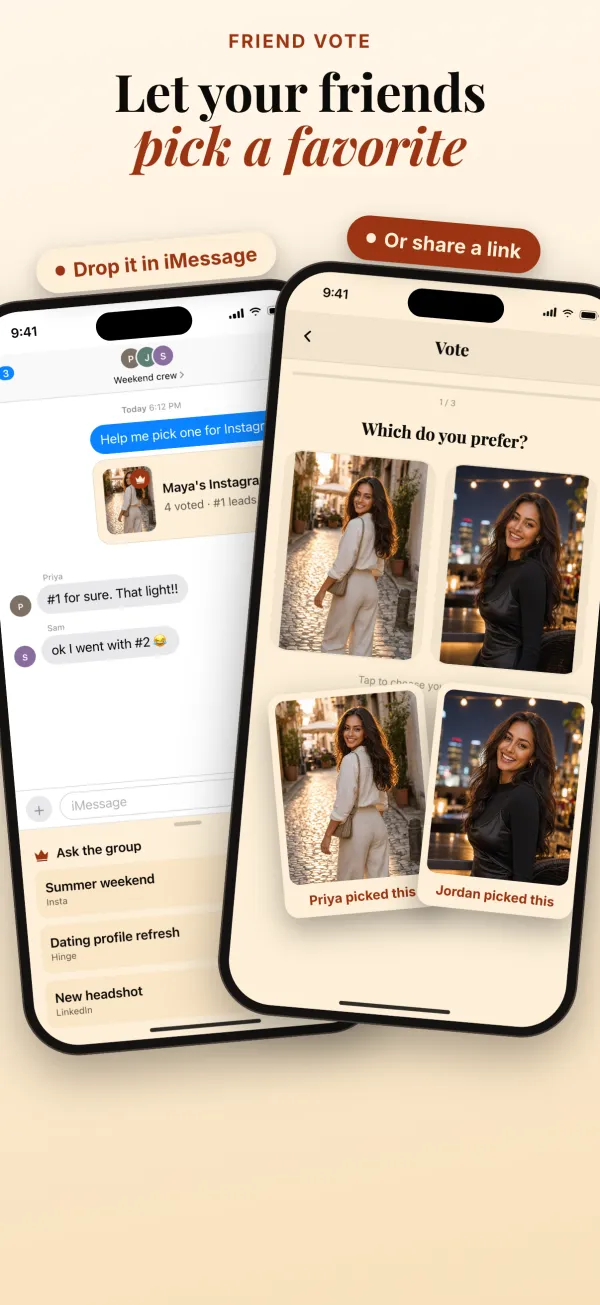
- Lets friends vote. Send a shortlist to people you trust and see their picks next to yours.
Free to try, no credit card. Paid plans, Pro ($4.99/month) and Creator ($14.99/month), are sold in the iPhone app and raise the limits on photos and projects. Only the photos you choose are uploaded, they are kept until you delete the project or your account, and Topit does not sell personal information. Details in the privacy policy.
Sources
- Hinge Help Center, "How do I edit my profile?" (four to six photos depending on local requirements). help.hinge.co/hc/en-us/articles/360011053094-How-do-I-edit-my-profile
- Hinge Help Center, "What is Top Photo?". help.hinge.co/hc/en-us/articles/26558052212627-What-is-Top-Photo
- Business Insider (2017), reporting Hinge's analysis of which profile photos get likes. www.businessinsider.com/profile-picture-tips-for-online-dating-according-to-hinge-2017-4
- Hinge Newsroom, profile refresh guide. hinge.co/newsroom/profile-refresh-guide
- White, Sutherland and Burton (2017), "Choosing face: the curse of self in profile image selection", Cognitive Research: Principles and Implications 2:23. A 2021 correction left the self versus other result standing. pmc.ncbi.nlm.nih.gov/articles/PMC5391387
- Ward et al. (2018), "Nasal distortion in short-distance photographs: the selfie effect", JAMA Facial Plastic Surgery 20(4). pmc.ncbi.nlm.nih.gov/articles/PMC5876805
- Willis and Todorov (2006), "First impressions: making up your mind after a 100-ms exposure to a face", Psychological Science 17(7). pubmed.ncbi.nlm.nih.gov/16866745